Photographer Captures A Once In A Lifetime Moment Of A Grizzly And Wolf Encounter

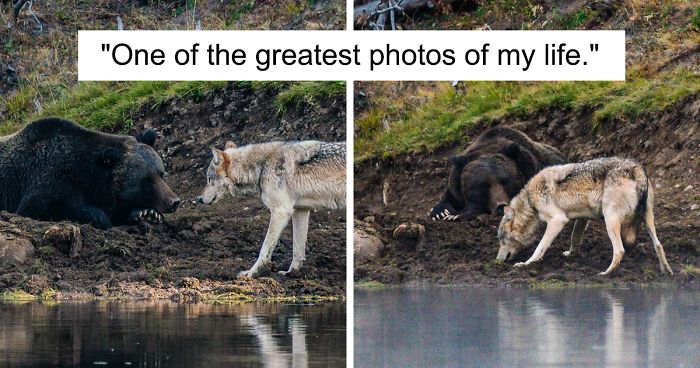
Wildlife photography often rewards patience with a distant silhouette, a twitching ear, oron a particularly generous morninga subject that remains visible long enough for autofocus to stop panicking. Montana photographer Seth Royal Kroft received something far rarer: a cinematic grizzly and wolf encounter unfolding beside an elk carcass on a misty Yellowstone riverbank.
The scene had nearly everything a nature photographer could ask for. There was a huge grizzly, a bull elk, a curious gray wolf, drifting fog, cold blue dawn light, and enough tension to make the forest feel as though it had hired its own screenwriter. Yet the photographs were not created through staging, baiting, or reckless proximity. They came from an early start, a long wait, a safe viewing position, and the good fortune of being present when two of Yellowstone’s most powerful predators briefly shared the same frame.
A 2 A.M. Alarm Led to an Extraordinary Yellowstone Morning
Kroft reportedly learned that a grizzly had drowned a large bull elk and pulled the carcass onto a riverbank in Yellowstone National Park. The bear had remained near its enormous food supply for days, creating a visible but strictly wild scene that drew photographers and wildlife watchers. Kroft set his alarm for 2 a.m., left about half an hour later, and reached the viewing area around 6 a.m. While waiting in the darkness, he prepared for sunrise with a hot cup of noodles and his Sony cameraan admirably practical breakfast when the wilderness has declined to install a coffee shop.
From roughly 150 yards away, he could initially make out little more than a dark shape across the river. As daylight strengthened and the fog began to lift, the grizzly, the antlers of the elk, the muddy bank, and the surrounding timber slowly emerged. Then, about 20 minutes before official sunrise, a lone gray wolf stepped out of the woods. The wolf left and returned several times over the next few hours, giving Kroft a sequence rather than a single lucky frame.
The Wolf Tested Its LuckAnd the Grizzly Barely Needed to Move
The wolf appeared interested in the elk but understandably less enthusiastic about the bear occupying the dining room. According to Kroft’s account, the wolf approached on four occasions. It crept close enough to the carcass to test the grizzly’s tolerance, then retreated whenever the bear stirred.
The body language mattered. The grizzly did not need to charge across the bank or launch into a dramatic battle. A small shift was enough. The bear’s confidence suggested that it did not view a solitary wolf as a serious threat. The wolf, meanwhile, seemed persistent, alert, and almost playfulbut never careless. It was essentially negotiating with a landlord who weighed several hundred pounds and had no interest in subleasing the elk.
That apparent imbalance fits the broader ecology of Yellowstone. National Park Service material notes that bears frequently attempt to displace wolves from kills and are usually successful. Wolves are formidable cooperative hunters, but their advantage depends heavily on numbers. One wolf facing a large grizzly over a carcass is in a very different position from a coordinated pack surrounding a competitor.
Why Grizzlies and Wolves Meet at Carcasses
Food Connects Yellowstone’s Predator Community
A large carcass is not simply a meal for one animal. It becomes a temporary ecological hub. Wolves may make the kill, bears may claim it, ravens and magpies may arrive almost immediately, coyotes may wait nearby, and smaller scavengers may consume what remains. Yellowstone’s elk are especially important in this network. The park describes elk as its most abundant ungulate and reports that they account for the great majority of wolf prey during winter while also feeding bears, mountain lions, birds, and numerous scavenger species.
In Kroft’s photographs, the carcass explains the entire composition. The grizzly was not wandering randomly near the water, and the wolf was not arriving for a social call. Both animals were responding to an energy-rich resource. In the wild, calories are currency. A bull elk represents a fortune, and every interested animal must decide whether a possible bite is worth the risk of injury.
Competition Does Not Always Mean Combat
Popular nature storytelling often frames predator encounters as winner-take-all fights. Real animals are usually better economists. An injury can reduce an animal’s ability to hunt, travel, defend young, or survive winter. As a result, many tense encounters are settled through posture, distance, movement, and previous experience rather than direct physical conflict.
The grizzly’s minimal response and the wolf’s repeated withdrawals illustrate this calculation. The bear conserved energy while maintaining possession. The wolf gathered information, tested openings, and avoided crossing the invisible line between boldness and disaster. Nothing exploded into a battle, but plenty happened. For anyone who reads animal behavior, the quiet negotiation is the story.
Yellowstone Made This Meeting Possible
Yellowstone is remarkable not merely because it contains charismatic animals, but because it supports a largely intact predator-prey community. The park is home to the largest concentration of mammals in the lower 48 states, including grizzly bears, black bears, wolves, coyotes, mountain lions, bison, elk, moose, and other large species. That diversity creates interactions that are difficult to observe elsewhere in the contiguous United States.
Gray wolves were reintroduced to Yellowstone beginning in 1995 after being absent as a breeding population for decades. Their return restored a major predator to the ecosystem and renewed opportunities to study how wolves interact with elk, bears, coyotes, scavengers, and the landscape itself. Researchers caution that Yellowstone’s food web is complex: wolf effects overlap with bear predation, mountain lions, weather, vegetation, hunting outside the park, and changing prey behavior. The result is not a tidy classroom diagram but a living system full of feedback loops and surprises.
Grizzlies, meanwhile, are North American members of the brown bear species. Their size, diet, behavior, and seasonal needs make them powerful competitors wherever they overlap with wolves. In Yellowstone, both species have long shared space and food. A photographed standoff may look exceptionaland visually it certainly isbut the underlying relationship is ancient.
Why the Photographs Feel Like a Dark Fairy Tale
Atmosphere Turned Documentation Into Storytelling
The encounter alone would have been memorable, but the weather transformed it. Fog simplified the background, softened distant detail, and separated the animals from the landscape. The river added reflection and visual space. The elk’s antlers created a graphic shape between predator and scavenger, while fallen timber framed the bank with the rough geometry of a wilderness stage set.
Low light also limited color, pushing the scene toward muted browns, blacks, grays, and cold greens. That restraint helped the photographs feel timeless. Remove the camera metadata and the images might seem like illustrations from an old frontier legendexcept the wolf is real, the grizzly is real, and neither signed a model release.
A Sequence Reveals More Than a Single Frame
A single photograph can show proximity, but a sequence shows behavior. The wolf approaches. The bear reacts. The wolf retreats. It returns. The pattern repeats. Seen together, the images reveal persistence, confidence, caution, and control.
This is one reason strong wildlife photography is more than collecting sharp portraits. A technically perfect image of an animal staring at the camera can be beautiful, but a behavioral series helps viewers understand relationships. Kroft’s photographs captured not just two famous species but an exchange: one animal defending a resource and another searching for a safe opportunity.
The Real Skill Was Patience, Preparation, and Distance
It is tempting to describe such images as pure luck. Luck certainly provided the wolf, the fog, and the timing. But luck works better when someone has already driven for hours in darkness, arrived before sunrise, prepared equipment, accepted uncomfortable weather, and remained attentive for an extended period.
Kroft’s safe distance was also central to the outcome. Yellowstone instructs visitors to remain at least 100 yards from bears and wolves and never approach wildlife for a photograph. Ethical wildlife photography follows the same basic principle: use a long lens, avoid baiting, do not force an animal to move, and place the animal’s welfare ahead of the image. If wildlife changes its behavior because of a photographer, the photographer is too close.
Those rules do more than protect people. They preserve authentic behavior. A wolf sneaking toward a carcass and a relaxed grizzly guarding it are valuable precisely because the animals are responding to one another, not to a human crowd pressing into their space.
What the Grizzly and Wolf Encounter Teaches Us
First, nature rarely follows the simple roles humans assign it. The grizzly is not a villain stealing food, and the wolf is not an underdog hero. Both are making decisions shaped by hunger, risk, strength, experience, and opportunity.
Second, dramatic wildlife behavior does not require violence. The most revealing moments may be a pause, a glance, a subtle rise of the shoulders, or a retreat made one second before a confrontation. The absence of a fight is not the absence of a story; sometimes it is evidence that both animals understood the stakes perfectly.
Finally, photographs can make ecological relationships visible to people who may never stand beside a Yellowstone river at dawn. They turn abstract ideascompetition, scavenging, predator restoration, habitat protectioninto an image viewers can immediately understand. That is where wildlife photography becomes more than spectacle. It becomes a doorway into conservation.
Field Experiences and Practical Lessons Inspired by the Encounter
The most useful experience to take from this story is that exceptional wildlife photographs are usually built long before the shutter clicks. The first decision is logistical: arrive when animals are active and light is changing. Dawn often offers cooler temperatures, less traffic, low-angle light, and greater wildlife movement. It also offers frozen fingers, fogged eyepieces, and the deeply philosophical question of why anyone owns an alarm capable of ringing at 2 a.m.
Preparation reduces the chaos. Batteries should be charged and kept warm, memory cards formatted, exposure settings chosen as a starting point, and the lens mounted before activity begins. In low light, photographers often need to balance shutter speed against noise. A motionless bear may tolerate a slower shutter, while a moving wolf demands more speed. Modern cameras handle high ISO settings well, but no sensor can rescue a blurred subject that has already trotted out of the frame.
Fog adds another challenge. Autofocus may hunt in low contrast, and automatic exposure can brighten the scene until the mood disappears. Experienced photographers check the histogram, watch highlights in pale mist, and use exposure compensation when necessary. They also resist the urge to “fix” every atmospheric condition. Fog is not an obstacle when it contributes depth, mystery, and separation; sometimes bad visibility is simply good storytelling wearing a damp coat.
Another lesson is to watch the entire scene, not only the main subject. A photographer locked onto the grizzly might miss the wolf emerging from the timber. Someone watching the wolf through a narrow telephoto view might overlook ravens landing near the carcass or the bear beginning to rise. Periodically scanning with the naked eyeor with binocularshelps reveal approaching animals and changing behavior. It is also safer than experiencing bear country exclusively through a rectangle.
Reading behavior improves both photographs and safety. Repeated glances, stiff posture, changes in ear position, sudden stillness, direct movement, and displacement can signal rising tension. The photographer’s job is not to provoke the next action. It is to recognize patterns while maintaining distance. Patience should never become pressure.
Field experience also teaches that a story may require hundreds of ordinary frames. Wildlife rarely performs on cue. There may be long stretches of sleeping, feeding, looking away, or standing behind the one branch in the entire landscape capable of ruining a composition. Keeping the camera ready matters, but so does accepting that observation is valuable even when the memory card remains quiet.
Finally, the best experience is often the realization that the photograph is secondary to the encounter. A photographer can miss focus and still witness something extraordinary. Conversely, a sharp image obtained by disturbing wildlife is a failure dressed as a success. Kroft’s grizzly and wolf photographs resonate because they preserve a wild interaction rather than manufacturing one. The animals controlled the scene; the photographer documented it.
Conclusion
Seth Royal Kroft’s once-in-a-lifetime grizzly and wolf encounter combined preparation, distance, atmosphere, animal behavior, and improbable timing. A lone gray wolf repeatedly tested access to a bull elk carcass while a massive grizzly maintained possession with almost comic efficiency. The fog and riverbank gave the photographs their haunting beauty, but the deeper power came from what they revealed: Yellowstone’s predators are connected through food, risk, competition, and restraint.
The images remind us that wild places do not need scripts. They need room, functioning ecosystems, ethical observers, and occasionally a photographer willing to wake before common sense does.


