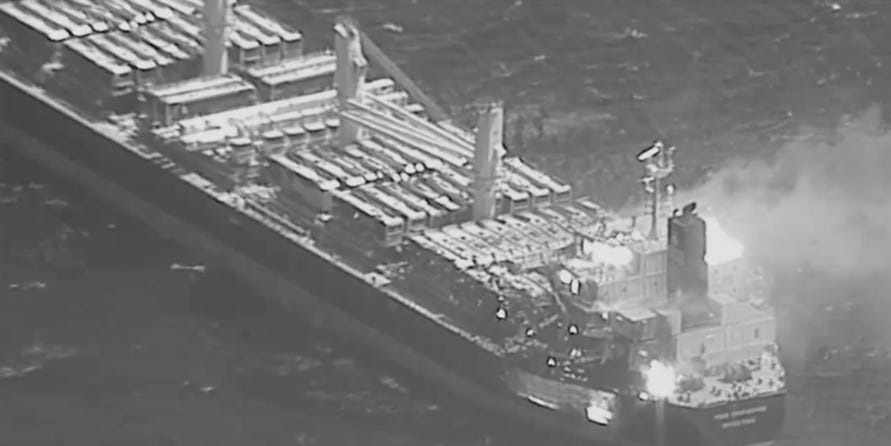

For months, the world watched Houthi missiles and drones streak across one of the planet’s busiest maritime corridors with a grim kind of suspense. Ships were hit. Crews were forced to abandon vessels. Insurance prices jumped like they had discovered espresso. Global shipping companies rerouted around Africa, adding time, fuel, and headaches to journeys that once seemed routine. Yet one chilling line had not been crossed: no commercial seafarers had been killed.
That changed on March 6, 2024, when an anti-ship ballistic missile launched from Houthi-controlled Yemen struck the M/V True Confidence in the Gulf of Aden. The Barbados-flagged, Liberian-owned bulk carrier was not a warship. It was part of the quiet machinery of global trade, carrying ordinary cargo through waters that connect Asia, the Middle East, and Europe. The attack killed three crew members and injured others, marking the first fatal strike in the Houthi campaign against merchant shipping.
The title sounds dramatic because the event was dramatic. But the deeper story is not only about one missile or one vessel. It is about how a regional conflict spilled into international waters, how modern missiles changed the risk calculation for commercial shipping, and how ordinary sailors became the human faces of a geopolitical crisis. In the Red Sea and Gulf of Aden, the map suddenly got personal.
What Happened to the M/V True Confidence?
The M/V True Confidence was transiting the Gulf of Aden near Yemen when it was hit by a Houthi anti-ship ballistic missile. U.S. Central Command said the missile was launched from areas of Yemen controlled by the Houthis and struck the vessel while it was underway. The ship suffered significant damage, the crew abandoned it, and coalition forces responded.
The crew was multinational, reflecting the reality of modern shipping: a vessel may be owned in one country, flagged in another, managed from a third, crewed by workers from several more, and carrying cargo for customers across continents. That complexity matters because the Houthis have claimed to target ships linked to Israel, the United States, or the United Kingdom. Yet the shipping industry is famously tangled. Ownership, financing, registration, operators, cargo, crew, destination, and past corporate relationships can all point in different directions. In other words, a ship can look “connected” on paper in ways that are outdated, indirect, or simply wrong.
That is one reason the True Confidence attack became so alarming. It suggested that the Houthi campaign was not a neat, narrowly targeted pressure tactic. It was a high-risk campaign in crowded waters where mistaken assumptions could be deadly. The Red Sea is not a private chessboard. It is a public highway, and the people traveling through it are often workers just doing their jobs.
Why the Houthis Are Attacking Ships in the Red Sea
The Houthis, also known as Ansar Allah, are an armed movement that controls much of northern Yemen, including the capital, Sanaa. Since late 2023, they have launched missiles, drones, and boat attacks against vessels in the Red Sea, Bab el-Mandeb Strait, and Gulf of Aden. The group says the campaign is linked to the war in Gaza and is intended to pressure Israel and its allies.
That explanation is politically powerful for the Houthis, especially inside Yemen and across parts of the region. It allows them to present themselves as defenders of Palestinians and challengers of Western influence. But analysts have also argued that the campaign serves the Houthis’ domestic interests. It gives the group international attention, rallies supporters, and shifts focus away from Yemen’s severe economic and humanitarian problems.
The practical result has been a maritime security crisis. Ships with unclear or disputed connections have been targeted. Commercial operators have been forced to make expensive choices. Naval forces from the United States and partner countries have intercepted drones and missiles, while also striking Houthi military sites in Yemen. The crisis has turned a narrow waterway into a global stress test.
Why the Red Sea Matters So Much
The Red Sea is not just a blue strip on the map. It is a major artery of global commerce. Ships moving between Asia and Europe often pass through the Bab el-Mandeb Strait, the Red Sea, and the Suez Canal. When that route becomes dangerous, companies divert vessels around the Cape of Good Hope at the southern tip of Africa. That detour adds days or weeks, burns more fuel, ties up ships, and increases costs.
For consumers, the connection may feel invisible at first. A delayed container does not knock on your door and introduce itself. But over time, disruptions can ripple into higher shipping rates, delayed inventory, tighter supply chains, and increased prices. Retailers, manufacturers, energy traders, insurers, ports, and logistics firms all feel the squeeze. The Red Sea crisis is a reminder that the global economy runs on ships, and ships run through chokepoints.
That is why the True Confidence attack was more than a tragic maritime incident. It was a warning flare. If missiles can make a major trade route feel unsafe, the cost is not limited to one vessel. It spreads through contracts, schedules, fuel bills, insurance premiums, and boardroom decisions. The sea may look empty from satellite photos, but economically speaking, it is crowded.
The Significance of Anti-Ship Ballistic Missiles
One of the most striking aspects of the Houthi campaign is the use of anti-ship ballistic missiles. Traditional anti-ship cruise missiles fly lower and more horizontally toward a target. Ballistic missiles travel in a high arc and descend at great speed. Anti-ship ballistic missiles are designed to threaten moving vessels, which makes them technically challenging and strategically disruptive.
For years, anti-ship ballistic missiles were discussed mostly in relation to major powers. The Red Sea crisis changed that conversation. A non-state armed group, backed and supplied in various ways by Iran according to U.S. and allied assessments, has used missiles and drones to threaten commercial shipping and naval forces. That does not mean every missile is accurate or every attack succeeds. Many have failed, missed, or been intercepted. But the True Confidence strike showed that even an imperfect campaign can eventually produce a deadly outcome.
This is the uncomfortable math of modern warfare: the attacker does not need to succeed every time. The defender must succeed again and again. A single missile getting through can transform the political and economic conversation overnight.
How Naval Forces Responded
The United States and partner nations launched Operation Prosperity Guardian in December 2023 to help protect commercial shipping in the Red Sea region. U.S., British, French, Indian, and other naval forces have played roles in intercepting drones and missiles, responding to distress calls, rescuing crews, and deterring attacks. U.S. warships have also used air-defense systems to shoot down incoming threats aimed at naval and commercial targets.
But defending merchant shipping is not like guarding a single building. The area is vast. Ships are constantly moving. Threats can come from the air, sea, or shore. Commercial vessels have different speeds, routes, risk profiles, and levels of security. Naval commanders must decide what to intercept, when to engage, and how to conserve limited defensive weapons while protecting lives.
There is also a cost problem. Shooting down relatively inexpensive drones or missiles with advanced interceptors can look inefficient on a spreadsheet. But that spreadsheet does not capture the value of a ship, its crew, its cargo, the surrounding environment, or freedom of navigation itself. The real question is not whether defense is cheap. It is whether allowing attacks to continue would be even more expensive.
Why the First Fatal Strike Changed the Conversation
Before the True Confidence attack, many discussions about the Red Sea crisis focused on trade disruption, insurance, military technology, and regional escalation. Those issues are important. But the deaths of seafarers forced a moral reset. The crisis was no longer only about shipping lanes and strategy. It was about people.
Commercial seafarers often live far from public attention. They move food, fuel, cars, steel, electronics, clothing, medicine, and raw materials across the world. They spend long stretches away from family. They work in dangerous weather, isolated environments, and demanding conditions. The Houthi missile campaign added a new danger: becoming a target in a conflict they did not choose.
That is why maritime unions and shipping groups reacted with alarm. Their message was simple: sailors are not bargaining chips. They are not symbols. They are workers. When armed groups attack commercial ships, the people most immediately at risk are not presidents, generals, or executives. They are crew members on watch, engineers below deck, cooks preparing meals, and officers trying to navigate through a tense waterway.
The Human Cost Behind the Headlines
War reporting often gets trapped in big numbers and bigger words: escalation, deterrence, disruption, retaliation. Those terms are useful, but they can make the human cost feel distant. The True Confidence attack cut through that distance. Three people died while doing civilian maritime work. Others were hurt. Survivors had to abandon ship and rely on rescue efforts in a dangerous region.
There is no need to describe the suffering in graphic detail to understand its seriousness. The essential fact is enough. A missile hit a commercial vessel, and families lost loved ones. The attack turned a shipping crisis into a human tragedy and made it harder for policymakers to treat the situation as background noise.
It also raised the stakes for every future transit. Captains had to think not only about fuel, cargo, and weather, but also about missile warnings. Shipping companies had to weigh the shorter Red Sea route against the safety of crews. Governments had to decide whether defensive patrols, strikes, sanctions, diplomacy, or some combination of all four could reduce the threat.
Global Shipping After the Attack
After the escalation, many shipping companies continued diverting around Africa. The detour is slower and more expensive, but for some operators it became the safer choice. Container lines were especially likely to avoid the route because delays and insurance costs could be managed more predictably than missile risk.
Other vessels continued to transit the region. Bulk carriers, tankers, and ships under different contractual pressures sometimes faced different calculations. A ship carrying lower-value cargo may accept risks that a container line will not. A tanker may have commitments that make rerouting difficult. A smaller operator may lack the flexibility of a global shipping giant.
This uneven response created a strange maritime landscape. The Red Sea did not close completely, but it became less reliable. That may sound like a small distinction, but reliability is the secret sauce of modern logistics. When companies cannot predict transit times, they add buffers, raise prices, shift inventory, and rethink supply chains. A route does not have to be fully blocked to become economically painful.
Could the Attack Have Been Prevented?
That question is easy to ask and hard to answer. Naval forces intercepted many Houthi missiles and drones before and after the True Confidence strike. But no defensive system can cover every commercial vessel at every moment. The region is too large, the traffic too complex, and the threat too persistent.
Prevention also depends on intelligence. If defenders know a launch is coming, they may have time to respond. If a ship receives warnings, it may change course. If diplomatic pressure works, attacks may slow. If launch sites are degraded, the number of threats may decline. But each layer has limits. Missiles can be mobile. Drones can be cheap. Targets can be misidentified. Messages can be ignored or misunderstood.
The uncomfortable lesson is that maritime security cannot rely on one tool. Escorts help, but there are not enough warships for every vessel. Strikes may destroy equipment, but they may not change behavior. Sanctions may raise costs for the Houthis, but they do not instantly remove missiles. Diplomacy is essential, but it moves slowly. The Red Sea crisis requires patience, coordination, and a clear focus on protecting civilian life.
What the Attack Means for U.S. and Allied Policy
The United States has long treated freedom of navigation as a core national interest. That principle is not abstract in the Red Sea. If armed groups can threaten shipping through a global chokepoint with repeated missile and drone attacks, the precedent matters far beyond Yemen. Other actors will watch how the world responds.
At the same time, military action carries risks. Strikes inside Yemen can fuel Houthi narratives, deepen regional tensions, and complicate humanitarian conditions in a country already battered by years of war. A purely military response may reduce immediate threats but fail to solve the political drivers behind them. A purely diplomatic response may be too slow to protect ships now. The policy challenge is finding a balance that is firm enough to protect seafarers and restrained enough to avoid a wider war.
That balance is difficult, which is why the Red Sea crisis has persisted. The Houthis gain attention from the campaign. Shipping companies adapt rather than wait for perfect security. Naval forces defend and strike, but the threat evolves. The result is a grinding contest where each side tests the other’s endurance.
Lessons from the True Confidence Strike
First, commercial ships are not outside conflict anymore.
The old assumption that merchant vessels can operate around wars without becoming direct targets looks increasingly shaky. In an era of drones, missiles, cyber tools, and proxy conflicts, civilian infrastructure can become part of the pressure strategy.
Second, “linked to” is a dangerous standard.
Modern shipping is legally and commercially complicated. If armed groups target vessels based on loose or outdated links, innocent crews will pay the price. The True Confidence case highlighted how quickly assumptions can become lethal.
Third, defense is necessary but not sufficient.
Warships can intercept threats and rescue crews, but they cannot erase the political conflict driving attacks. Maritime security must be paired with diplomacy, sanctions enforcement, regional cooperation, and support for de-escalation.
Fourth, seafarers deserve more attention.
Consumers rarely think about the people who move goods across oceans. The Red Sea crisis should change that. Global trade depends on human labor, not just ships, ports, and tracking apps.
Experiences and Real-World Takeaways from the Red Sea Crisis
For people who work around shipping, the True Confidence attack felt like a door closing. Before the first fatal strike, there was still a little room for optimism. Maybe the attacks would remain mostly symbolic. Maybe missiles would miss, drones would be intercepted, and shipping would adapt with delays but not deaths. After March 6, that optimism became harder to defend. The crisis moved from “dangerous disruption” to “deadly disruption,” and the difference matters.
Imagine being a ship captain preparing to enter the Gulf of Aden after the attack. Your job is practical: keep the vessel safe, follow instructions, manage crew morale, communicate with owners, monitor advisories, and maintain the schedule as best you can. But now every radar contact feels more serious. Every radio message matters. Every decision to continue, slow, divert, or wait carries weight. The sea has always required judgment, but missile risk adds a pressure that no ordinary checklist can fully absorb.
For crew members, the experience is even more personal. Many seafarers come from countries where maritime work supports entire families. A contract at sea can pay school fees, cover medical bills, or help build a home. These workers are not looking for geopolitical drama. They are trying to earn a living. When their vessel enters a high-risk area, they may worry quietly and keep working because that is what professionals do. The galley still needs meals. The engine room still needs attention. The bridge still needs watchkeepers. Courage at sea often looks less like a movie scene and more like people doing routine tasks under abnormal stress.
For shipping managers, the crisis becomes a brutal spreadsheet with human consequences. The Red Sea route is shorter, but riskier. The Cape of Good Hope route is safer, but longer and more expensive. Insurance premiums climb. Customers complain about delays. Crews ask hard questions. Regulators issue guidance. Security consultants update threat assessments. Every choice is imperfect, and nobody gets applause for avoiding a disaster that never happens. That is the strange thing about prevention: when it works, it looks boring. When it fails, it becomes breaking news.
For ordinary consumers, the experience is distant but real. You may never check vessel-tracking data or read maritime advisories, but your life is connected to those routes. The phone in your pocket, the coffee machine on your counter, the car parts in a repair shop, the clothes in a store, and the grain moving between markets may all depend on ocean transport. When the Red Sea becomes dangerous, the effects do not arrive with a dramatic soundtrack. They arrive as delays, price changes, shortages, and quiet adjustments in supply chains.
The biggest takeaway is simple: global trade is not automatic. It depends on safe passages, skilled crews, stable rules, and enough trust that ships can move without becoming targets. The True Confidence attack reminded the world that the people who keep commerce moving are vulnerable. Protecting them is not just a military problem or a shipping industry problem. It is a shared responsibility in a world where one missile can disturb an entire route, and one tragedy can reveal how connected we all are.
Conclusion
The first fatal Houthi missile strike on commercial shipping was a turning point in the Red Sea crisis. The attack on the M/V True Confidence showed that persistent missile and drone campaigns can eventually break through defenses and impose a human cost. It also exposed the fragility of global shipping routes that many people rarely think about until something goes wrong.
The Houthis framed their campaign as political pressure linked to Gaza, but the practical effect has been broader and more dangerous: disrupted trade, higher risk for civilian crews, increased military deployments, and a more unstable maritime environment. The Red Sea remains a vital artery of world commerce, and keeping it safe requires more than slogans or quick fixes.
In the end, the story of the True Confidence is not only about missiles. It is about seafarers, families, trade, deterrence, and the cost of letting regional conflicts spill into international lifelines. The world can argue strategy all day. But for the crews who sail these waters, the most important goal is simpler: get home safely.
Note: This article is intended for public information and editorial analysis. It does not provide military, operational, or tactical guidance.


